
BMB Stripper
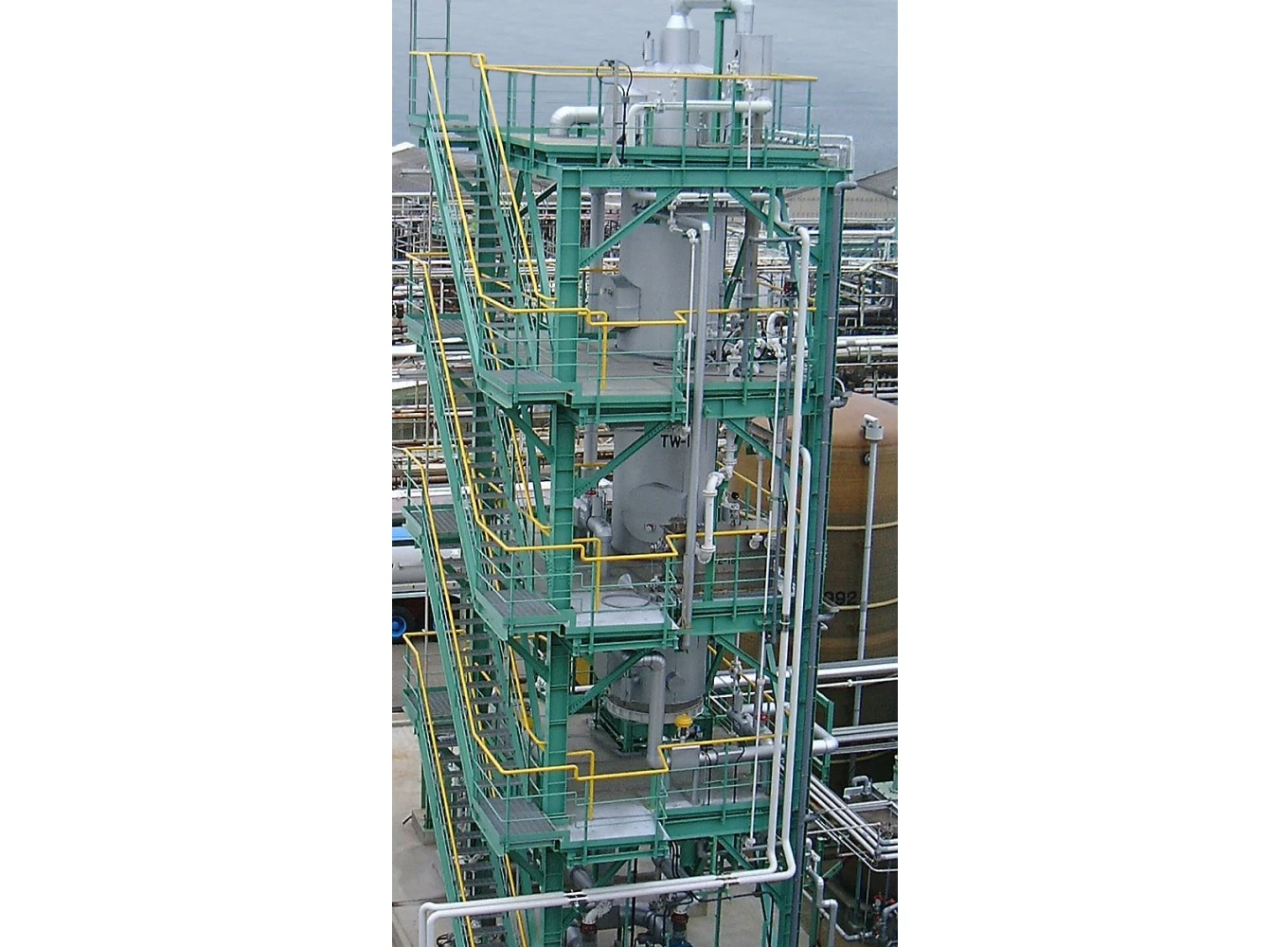
Distillation method is effective for removing small levels of VOCs in water. However with the BMB stripper, the gas flows closer to the plug flow, which maintains the vertical concentration difference.
- Absorption and adsorption technology
Distillation effectively removes low level of VOCs in water, but large amount of steam energy is required. With the BMB stripper, steam energy consumption can be reduced by bringing the gas flow closer to the plug flow.
VOCs in water are removed by conventional aeration by releasing them into the air to prevent water contamination. Distillation method is effective for removing small levels of VOCs in water. However, large amounts of steam and energy are required for conventional methods because reducing the amount of steam causes the downward liquid to mix with the upward steam flow, so concentration becomes vertically uniform to the tower, disabling direction control/countercurrent flow of liquid and gas.
However with the BMB stripper, the gas flows closer to the plug flow, which maintains the vertical concentration difference. The liquid flows down in the tower as it contacts with gas and concentration of organic compounds decreases gradually to less than the permissible level, then discharged from the base of the tower. As steam flows upward, concentration of organic compounds increases, allowing for their recovery and reuse. Use of little steam allows increasing the concentration of organic compounds, so solvent phase and aqueous phase can be separated efficiently with a decanter.
Semiconductor,LCD / Steel,Metal,Paper,Inorganic Chemical / Medical,Food,Biochemical
Features
- Concentration of organic compounds can be processed until it is less than the environmental standard
- No release of toxic substances into the air
- Efficient recovery of components
- Economic with extremely low consumption of utilities
- Highly reliable automatic continuous operation
- Quick and easy start-up and stop
- Virtually maintenance-free
Major Applications
Removal and recovery of VOCs in wastewater
Applicable Toxic Materials
The BMB stripper decreases the concentration of toxic materials stated below to the level of environmental standard or less.
| Toxic material | Standard Permissible Concentration of Wastewater (mg/L) |
|---|---|
| trichloroethylene | 0.3 |
| tetrachloroethylene | 0.1 |
| dichloromethane | 0.2 |
| carbon tetrachloride | 0.02 |
| 1,2-dichloroethane | 0.04 |
| 1,1- dichloroethylene | 0.2 |
| cis-1,2- dichloroethylene | 0.4 |
| 1,1,1-trichloroethane | 3.0 |
| 1,1,2-trichloroethane | 0.06 |
| 1,3-dichloropropene | 0.02 |
| benzene | 0.1 |
System Flow
Product Lineup
-
Catalytic WAO Effluent Water Treatment System

-
Submerged Combustion System
-
BMB Stripper
-
Dioxins Decomposition Catalyst
-
Local Exhaust Ventilation and Combustion System
-
Fluorocarbon Destruction System
-
BMB Absorber
-
Fluidized-bed Incineration System
-
Kiln Gasification System
-
Melting Kiln System
-
Solvent Recovery and Refining System
-
Acid Recovery and Concentration System
-
Ammonia Separation and Decomposition Process
-
Tower Internals
-
SPIRAX
-
Raschig Super-Ring
-
Thermal Oxidizer
-
Raschig Super-Pak
-
Chlorine Drying Process