
Catalytic WAO Effluent Water Treatment System
High-efficiency liquid-phase oxidation reaction
process is used effectively for treating
wastewater with intermediate/low
concentration of COD components. The system
requires no application for the Waste
Management and Public Cleansing Law as no
fuel is used to treat wastewater under increased
temperature and pressure. Combined with the
catalytic technology from Nippon Shokubai Co.,
Ltd., the system achieves further space and
energy savings.
- Reaction and reforming technology
Features
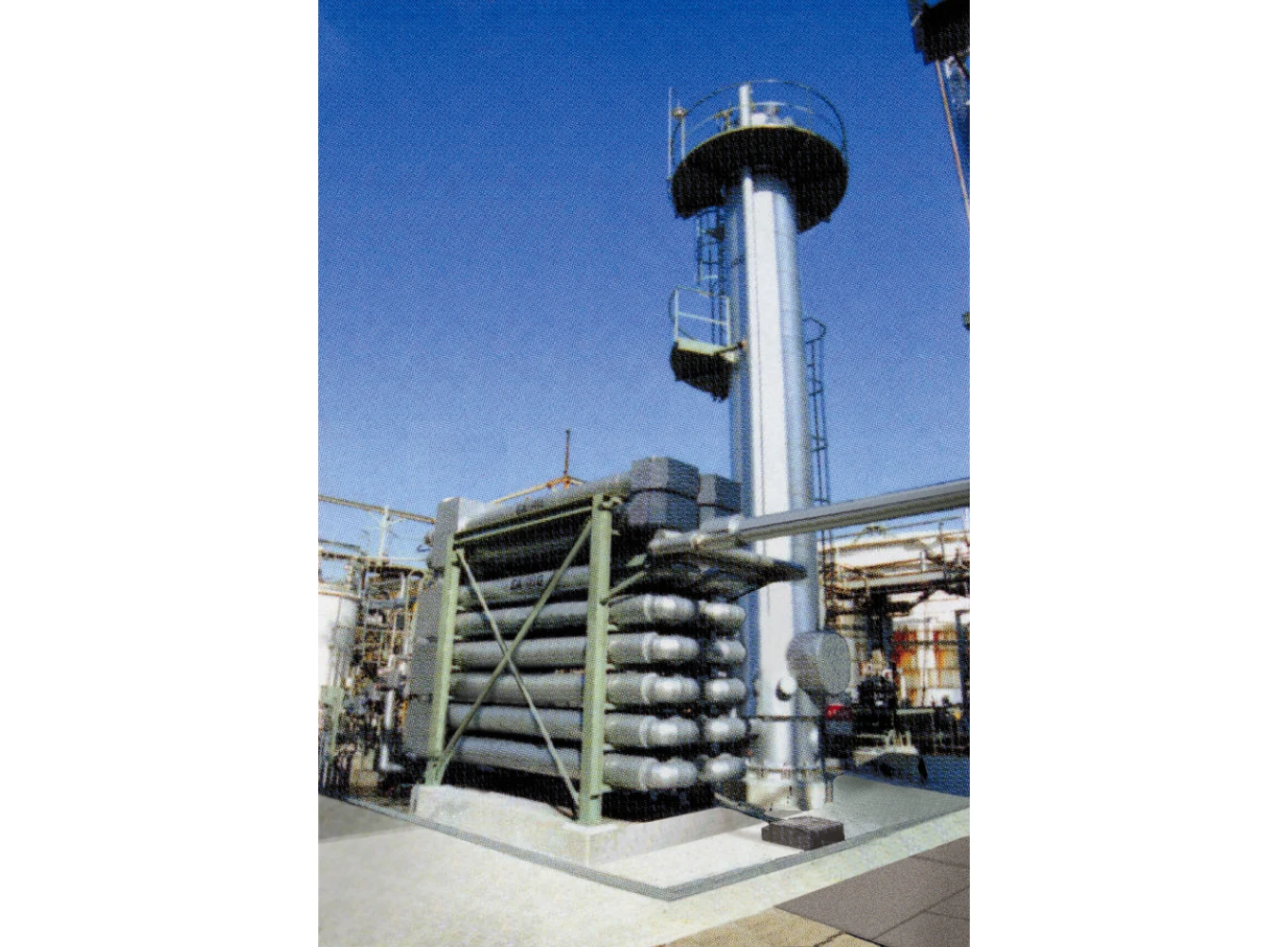
Detoxifying COD components in Effluent water by catalyst with high-efficiency liquid phase oxidation reaction WAO is a high-efficiency liquid-phase oxidation reaction
process developed under technical license from Nippon Shokubai Co., Ltd. High running costs were a drawback for conventional combustion treatment. With WAO,
a solid catalyst performs efficient liquid-phase oxidation and decomposition of COD components such as organic, nitrogen and sulfuric compounds in effluent water,
at high temperature and high pressure. WAO not only exhibits high performance for persistent cases that are difficult with biological treatment,
but is effective for treating effluent water with much inorganic COD components as well.

Comparison of WAO with Combustion Treatment
Saves energy as fuel is not required
Decreases environmental load as NOx SOx and dioxins are not included in exhaust gas
No application is required to install WAO in relation to Waste Disposal Law
Comparison with biological treatment
No generation of secondary waste such as organic sludge typically associated in biological treatment
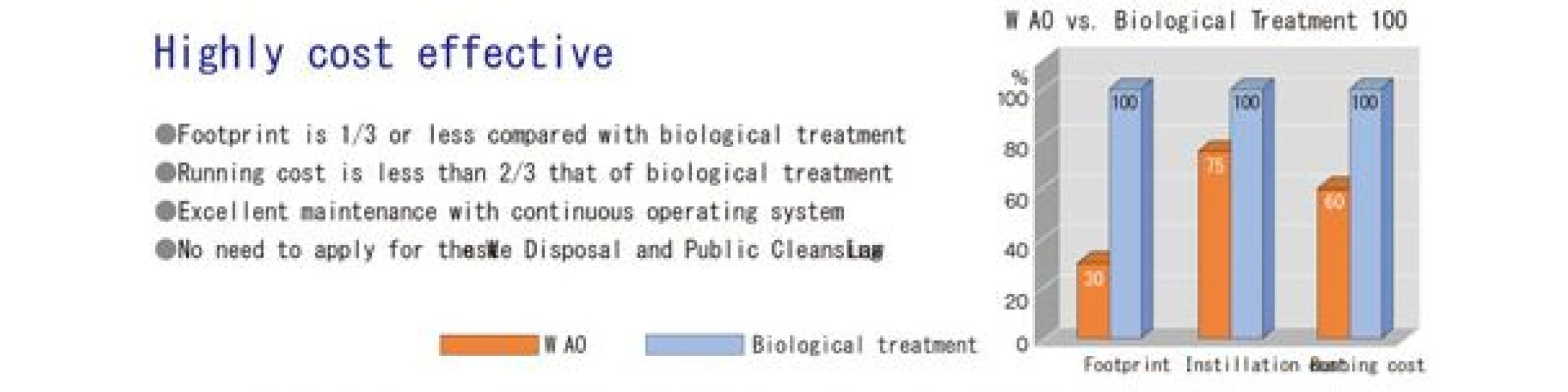
Running cost is 2/3 or less and footprint is 1/3 or less
- Advanced treatment recycles treated effluent as service water
- No secondary pollution as catalyst itself is non-toxic
- Treats wastewater that is difficult to treat biologically
- Exhaust gas contains no NOx, SOx or dioxins
- Treats 10~500 ton/day of compounds
- Applies for decolorization
| Evaluation items | Sample volume |
|---|---|
| Concentration and composition analysis | About 2 liters |
| Concentration and composition analysis + autoclave test |
2 to 5 liters |
| Concentration and composition analysis + testing with small continuous machine |
About 20 liters |
| Bench test | 1,000 liters |
・Main Application
Removal and detoxification of COD components in effluent water
・WAO Process
WAO process decomposes organic compounds into air, oxidant, CO2 and water in the catalytic reaction chamber. Nitrogen compounds are decomposed into N2, generating virtually no NOx. Sulfuric compounds are detoxified after their sulfur components are changed into Na2SO4 through decomposition with a catalyst and addition of NaOH solution.
・Operative Conditions
Low / pressure method
~0.9MPaG(9kgf/c㎡),
~165℃ (Pressure vessels of Grades 1 and 2)
High / pressure method ~7.3MPaG(73kgf/c㎡),
~265℃ (High-Pressure Gas Safety Law, Pressure vessel of Grade 1)
How to Verify
To install +WAO, a test to verify the applicability of the catalytic treatment device is required.
High-performance catalysts
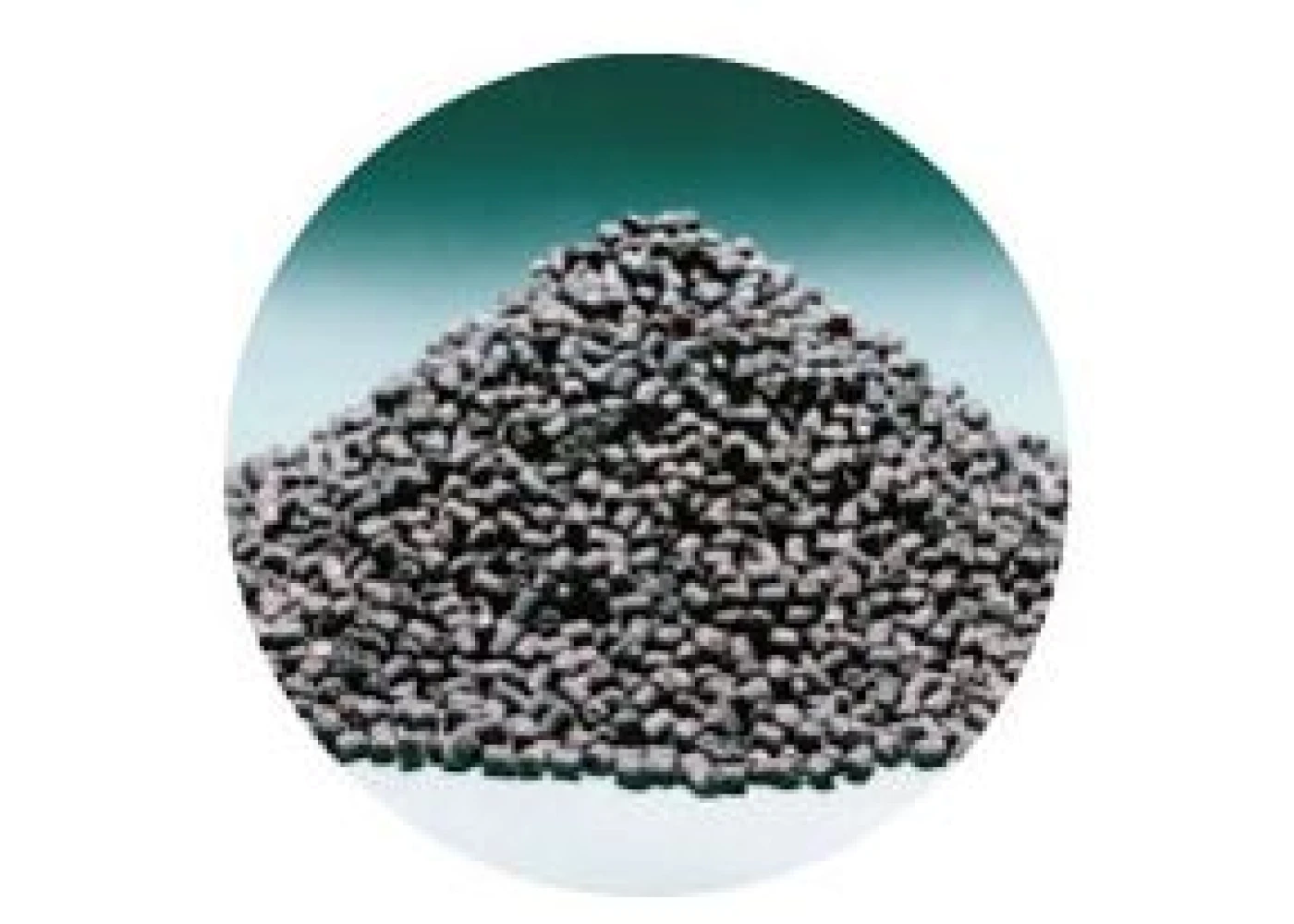
- We use high-performance catalysts made by Nippon Shokubai Co., Ltd.
- Catalysts with excellent durability are selected to meet conditions of wastewater.
Product Lineup
-
Catalytic WAO Effluent Water Treatment System

-
Submerged Combustion System
-
BMB Stripper
-
Dioxins Decomposition Catalyst
-
Local Exhaust Ventilation and Combustion System
-
Fluorocarbon Destruction System
-
BMB Absorber
-
Fluidized-bed Incineration System
-
Kiln Gasification System
-
Melting Kiln System
-
Solvent Recovery and Refining System
-
Acid Recovery and Concentration System
-
Ammonia Separation and Decomposition Process
-
Tower Internals
-
SPIRAX
-
Raschig Super-Ring
-
Thermal Oxidizer
-
Raschig Super-Pak
-
Chlorine Drying Process